Abstract
Sierra Leone stands at an inflection point. A single case; the presence within its borders of Joseph Johannes Leijdekkers, a Dutch fugitive convicted in absentia of orchestrating industrial-scale cocaine trafficking, contract killings, and armed extortion has, over the course of 2025 and 2026, escalated from a discreet law-enforcement irritant into a full-blown crisis of international confidence. What began as a Dutch extradition request has since drawn in the European Union (EU), the European Parliament, neighbouring West African governments, and an increasingly attentive international press corps. The costs are no longer hypothetical: they include a threatened suspension of roughly €352 million in EU development assistance for the 2021—2027 period, formal motions before the European Parliament, and a reputational connection between the Sierra Leonean state and one of Europe's most wanted criminals that will not easily be undone. This paper sets out, in three (3) parts, the evidentiary and analytical basis for a candid national reassessment. Part One examines the profile of Leijdekkers, also known as “Bolle Jos” and the architecture of the transatlantic cocaine trade that has made West Africa, and by extension Sierra Leone, an increasingly attractive transshipment corridor. Part Two catalogues the specific allegations and diplomatic fallout connecting the fugitive to Sierra Leone and, reportedly, to individuals close to the presidency. Part Three assesses the compounding risks this episode poses on two fronts: the diplomatic and international-relations front, where Sierra Leone's development partnerships, credit standing, and regional leadership ambitions are all exposed; and the national-security front, where the normalisation of a trafficker's presence threatens to entrench the very state-capture dynamics that turned a country like Guinea-Bissau into the region's cautionary tale. The paper does not adjudicate guilt. It treats contested claims including reports, attributed by name in for instances Reuters, CBS News, and Africa Confidential reporting, of a personal relationship between Leijdekkers and Agnes Bio, confirmed to be a daughter of President Julius Maada Bio as allegations that remain officially unacknowledged by the Government of Sierra Leone, while noting that the volume, consistency, and specificity of independent reporting on the matter have made the allegations themselves a strategic fact the Government must manage, irrespective of their ultimate legal resolution. The paper closes with concrete, actionable recommendations designed to allow Sierra Leone to reclaim the narrative, protect its development partnerships, and forestall the security degradation that has accompanied comparable trafficking entrenchment elsewhere on the West African coast.
Sierra Leone stands at an inflection point. A single case; the presence within its borders of Joseph Johannes Leijdekkers, a Dutch fugitive convicted in absentia of orchestrating industrial-scale cocaine trafficking, contract killings, and armed extortion2 has, over the course of 2025 and 2026, escalated from a discreet law-enforcement irritant into a full-blown crisis of international confidence. What began as a Dutch extradition request has since drawn in the European Union (EU), the European Parliament, neighbouring West African governments, and an increasingly attentive international press corps. The costs are no longer hypothetical: they include a threatened suspension of roughly €352 million in EU development assistance for the 2021—2027 period,3 formal motions before the European Parliament,4 and a reputational connection between the Sierra Leonean state and one of Europe's most wanted criminals that will not easily be undone.5
This paper sets out, in three (3) parts, the evidentiary and analytical basis for a candid national reassessment. Part One examines the profile of Leijdekkers, also known as “Bolle Jos” and the architecture of the transatlantic cocaine trade that has made West Africa, and by extension Sierra Leone, an increasingly attractive transshipment corridor. Part Two catalogues the specific allegations and diplomatic fallout connecting the fugitive to Sierra Leone and, reportedly, to individuals close to the presidency. Part Three assesses the compounding risks this episode poses on two fronts: the diplomatic and international-relations front, where Sierra Leone's development partnerships, credit standing, and regional leadership ambitions are all exposed; and the national-security front, where the normalisation of a trafficker's presence threatens to entrench the very state-capture dynamics that turned a country like Guinea-Bissau into the region's cautionary tale.
The paper does not adjudicate guilt. It treats contested claims including reports, attributed by name in for instances Reuters, CBS News, and Africa Confidential reporting, of a personal relationship between Leijdekkers and Agnes Bio, confirmed to be a daughter of President Julius Maada Bio6 as allegations that remain officially unacknowledged by the Government of Sierra Leone, while noting that the volume, consistency, and specificity of independent reporting on the matter have made the allegations themselves a strategic fact the Government must manage, irrespective of their ultimate legal resolution. The paper closes with concrete, actionable recommendations designed to allow Sierra Leone to reclaim the narrative, protect its development partnerships, and forestall the security degradation that has accompanied comparable trafficking entrenchment elsewhere on the West African coast.
1. Introduction
On 1 January 2025, a New Year thanksgiving service at St. Joseph's church in Tihun, the ancestral home village of Sierra Leone's President Julius Maada Bio, in the Southern Province, was attended by dozens of family members and senior government officials, including Chief Minister Dr. David Sengeh.7 Video footage of the service, later obtained and syndicated internationally by Reuters, showed a heavy-set foreign-like Caucasian man seated two rows behind the President and First Lady Fatima Maada Bio, engaged in conversation with a woman later identified as Agnes Bio, the President's daughter.8
That man was subsequently identified by Dutch investigative journalists, and confirmed by Reuters, CBS News, and other international outlets, as Joseph Johannes Leijdekkers “Bolle Jos” the most wanted fugitive on the Dutch National Most Wanted List and a listee on the European Union's most-wanted persons register.9 Dutch state prosecutors told Reuters in January 2025 that they had already known Leijdekkers's whereabouts in Sierra Leone for approximately six months prior to the footage becoming public.10 What might, in an earlier era, have remained a matter for quiet law-enforcement cooperation between The Hague and Freetown has instead become one of the most consequential diplomatic controversies to touch Sierra Leone in a generation. This paper examines why, and at what cost.
2. Jos Leijdekkers: Profile of a Transnational Trafficker
2.1 Criminal Career and Convictions
Born on 1 July 1991 in Breda, The Netherlands, Leijdekkers first came to police attention over a 2011 shooting in Scheveningen, for which he served six years for attempted manslaughter.11 On his release, he rose within the upper echelon of the Dutch organised-crime milieu, becoming associated with figures such as Ridouan Taghi and Edin Gačanin, principals of what Dutch prosecutors have described as the country's most violent narcotics syndicate.12 He has been linked by Dutch investigators, per Europol, to the 2019 disappearance and presumed killing of Naima “Tante” Jillal, and to the so-called Cherokee cocaine-trafficking case in Amsterdam-Zuidoost.13
Leijdekkers has since been convicted in absentia in both The Netherlands and Belgium on charges spanning large-scale cocaine importation, incitement to murder, aggravated assault, armed robbery, and attempted extortion. In The Netherlands, he was sentenced to twenty-four years' imprisonment and ordered to pay approximately €96 million to the Dutch state. In Belgium, he has been sentenced in absentia to a cumulative fifty-seven years for cocaine trafficking, theft, and conspiracy to murder.14 In July 2025, the Rotterdam District Court additionally confiscated his nearly €127 million in assets it determined to be criminal proceeds, ordering repayment of more than €96 million of that sum, after prosecutors' initial claim of €250 million was reduced for want of sufficient evidentiary basis on certain items.15 Since May 2022, Leijdekkers has featured on both the Dutch national and EU most-wanted lists.16
2.2 Modus Operandi and Present Scale of Operations
Dutch authorities allege that Leijdekkers has continued to direct trafficking operations from abroad, using corrupted port employees and a network of intermediaries to move multi-tonne cocaine shipments from Latin America into European ports.17 An investigation by the Turkish daily BirGün, citing a leaked police file, reported that Leijdekkers laundered millions of euros through shell companies and gold bullion flown to Dubai while residing in Turkey under a residence permit later revoked at Dutch authorities' urging.18 Dutch Justice and Security Minister David van Weel has publicly estimated Leijdekkers's personal income at hundreds of millions of Euros per month, a figure he has repeatedly juxtaposed against Sierra Leone's own gross national income to argue that proceeds of this magnitude are structurally capable of corrupting the institutions of a small state.19 In the spring of 2026, Spanish authorities intercepted a vessel near the Canary Islands carrying more than 30,000 kilograms of cocaine distributed across 1,279 packages (among the largest single maritime cocaine seizures on record) which Dutch investigators publicly linked to Leijdekkers's network and to a vessel that had departed Sierra Leonean waters.20 A separate consignment of approximately eight tonnes was later discovered concealed within a shipping container of cocoa beans exported from Sierra Leone to Germany, and was likewise linked by investigators to the network.21
3. The Global and West African Cocaine Trade: Structural Context
Sierra Leone's exposure to this case cannot be understood in isolation from the broader transformation of West Africa into a primary transshipment corridor for Andean cocaine bound for European markets. The United Nations Office on Drugs and Crime has for over a decade warned that the region risks becoming a structural node in the global cocaine trade, with dozens of tonnes of Colombian, Peruvian, and Bolivian products moving annually through West African littoral states for onward shipment to Europe, where retail values run into the billions of euros.22
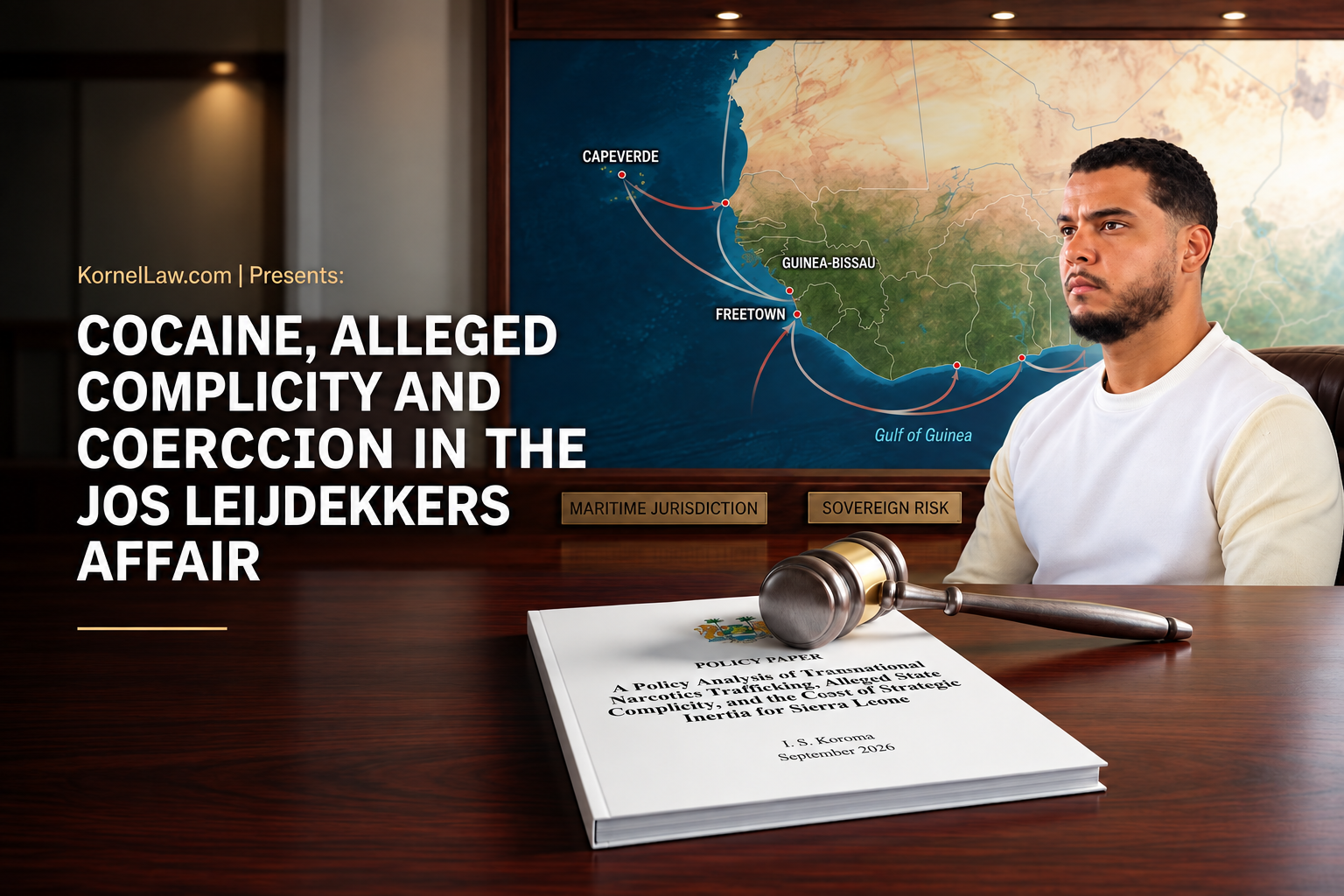
Contemporary reporting on the corridor identifies a layered geography of risk: Guinea-Bissau's Bijagós archipelago as the principal offshore transshipment point for multi-tonne consignments; the Gulf of Guinea as the main theatre for “mother-ship” interdiction, exemplified by French Operation Corymbe seizures of 10.7 tonnes in March 2024 and 9.6 tonnes in September 2025; and a widening set of tactics such as, semi-submersible “narco-subs,” rigid-hulled inflatable boats, and at-sea transfers to smaller “daughter” vessels, engineered to defeat coastal surveillance.23 An investigation published by The Economist similarly identified Sierra Leone's geographic position between Guinea-Bissau and Côte d'Ivoire, and estimated that roughly one-third of the cocaine now reaching Europe transits West Africa, with Sierra Leone increasingly cited alongside Côte d'Ivoire, Senegal, and Cabo Verde as a key node.24 Analysts have also documented the entrenchment, since 2019, of Balkan organised-crime networks across Senegal, the Gambia, Guinea-Bissau, Sierra Leone, Guinea, and Cabo Verde, exploiting weak port controls to push consignments toward Europe.25
Sierra Leone's own domestic drug crisis compounds this exposure. The country has, together with Liberia, declared a national public-health emergency over “kush,” a synthetic drug mixture containing nitazenes and synthetic cannabinoids that emerged in Freetown and its environs and is now the leading cause of drug-treatment admissions around the country but mainly in the outskirts of the capital and south of the country.26 A state already feeling the strain of managing a homegrown synthetic-drug epidemic is, on the present trajectory, simultaneously being drawn into the higher tier of transnational cocaine logistics, a combination that has historically proven very difficult to reverse once entrenched.
4. The Sierra Leone Nexus: Timeline of Allegations and Evidence
4.1 Emergence of the Allegations
Journalists at the Dutch newspaper AD and the investigative outlet Follow the Money have stated that they pursued the story for months, on the basis of information from African sources including local business leaders and opposition figures, before the church-service footage surfaced and made the story impossible to contain quietly.27 On 26 January 2025, Sierra Leone's Ministry of Information stated that the Government “has not received any formal communication from any country or institution” regarding Leijdekkers; Information Minister Chernor Bah subsequently reiterated that position.28 That position that no formal foreign request had been received, has remained the Government's public line and has not, to date, been superseded by a more detailed public account.
A separate and independently significant incident followed on 7 March 2025, when investigative outlets published video showing Sierra Leone's then immigration chief, Alusine Kanneh, receiving a gift from Leijdekkers at a Freetown restaurant; President Bio dismissed Kanneh shortly thereafter.29 Attorney-General & Minister of Justice Alpha Sesay later informed the media that he received a formal request from his Dutch counterpart and has met at least once and discussed the matter but no additional information was leased beyond reviewing the request.
4.2 The Alleged Personal Dimension
A recurring and more sensitive element of the reporting concerns the claim, now attributed by name in Reuters-sourced reporting republished by CBS News and independently corroborated in a special report by Africa Confidential, that Leijdekkers's partner is Agnes Bio, aged 30, a daughter of President Bio, and that the two have been photographed together in romantic settings on social media.30 Sierra Leonean opposition figure Mohamed Kamarainba Mansaray who is on self-imposed exile has publicly accused President Bio and his government of “offering refuge” to Leijdekkers on this basis.31 These claims have not been confirmed in any judicial forum, and the Government of Sierra Leone (GoSL) has not issued a public statement specifically addressing them. Therefore, this paper treats the claim accordingly: as a reported and increasingly well-sourced allegation, but one that remains formally unadjudicated, and it notes that the allegation has already acquired independent diplomatic weight, being cited routinely by Dutch officials, European parliamentarians, and international media as the explanatory factor behind GoSL's reluctance to act.
4.3 The Legal Obstacle and the Interdiction Episodes
A threshold legal complication compounds the political one: The Netherlands has no extradition treaty with Sierra Leone, meaning GoSL could voluntarily surrender Leijdekkers but is under no treaty obligation to do so.32 Separately, Dutch reporting indicates that specialised units of the National Police and the Royal Netherlands Navy twice came close to intercepting Leijdekkers at sea off the West African coast, including one operation in which an undercover vessel was reportedly positioned in international waters after intelligence suggested Leijdekkers intended to travel by boat from Sierra Leone to Liberia.33 Both operations were ultimately aborted when the fugitive did not move as anticipated. A Dutch prosecution spokesperson told Reuters that arresting Leijdekkers remained “the highest priority of police and prosecutors,” while declining to confirm or deny specific tactical operations.34
5. Diplomatic Fallout: Escalating Pressure from The Hague, Brussels, and the Region
5.1 Bilateral Dutch Pressure
The Netherlands has pursued a graduated escalation strategy. Repeated bilateral requests for cooperation were, according to Minister Van Weel, met for over six months with assurances that “procedures are underway” but no concrete action.35 In mid-2026, Van Weel shifted to a regional approach, using visits to Ghana to build a coalition of West African states; reportedly including Liberia and Ghana, prepared to raise the reputational and security risk that Leijdekkers' presence poses to the wider region.36 Minister Van Weel has stated that Sierra Leone's own Justice Minister subsequently requested a meeting, and that he detected “a willingness to talk” but not yet “the willingness to take concrete steps.”37
5.2 The EU Aid Lever
In June 2026, the Dutch Cabinet formally moved to enlist the European Union, asking fellow member states to support suspending the roughly €352 million in EU development grants earmarked for Sierra Leone for 2021—2027, covering infrastructure, agriculture, health, education, and governance-reform programming.38 Van Weel again characterised the underlying logic bluntly, stating that it was “bizarre” for the EU to continue supporting a country that was simultaneously providing safe harbour to one of the world's most significant drug traffickers.39 Independent fact-checking organisations have since confirmed the substance of these reports, while flagging embellished versions circulating on Sierra Leonean social media.40
5.3 The European Parliament Escalation
The controversy reached the European Parliament for the first time on 16 September 2026, when legislators advanced measures targeting jurisdictions perceived to be sheltering fugitives from EU justice, with West Africa (and Sierra Leone specifically) named as a focal point; reported measures under consideration include suspension of EU development aid and targeted visa restrictions on senior officials suspected of obstructing extradition efforts.41 Separately, Dutch MEP Malik Azmani has formally petitioned the European Commission to intensify pressure on GoSL, framing Sierra Leone's cooperation as a test case for the EU's capacity to enforce judicial cooperation against transnational organised crime, and describing the country as an increasingly significant node in the cocaine trade destined for European markets.42
5.4 Sierra Leone's Counter-Framing
Sierra Leonean officials have, according to reporting, responded to the Dutch campaign with sharp pushback, characterising the pressure campaign, and in particular the aid-suspension threat as an instance of neo-colonial coercion by a wealthy European state against a smaller, developing nation and a blackmail.43 This framing carries genuine rhetorical force in a region with a well-founded historical sensitivity to external interference; it does not, however, resolve the underlying evidentiary problem: independent journalism from at least four separate national press traditions (Dutch, Sierra Leonean, British, and Turkish), Dutch and Belgian judicial documentation, satellite-verifiable seizure data, and now formal EU parliamentary proceedings each point in the same direction. A defence grounded solely in the illegitimacy of the messenger becomes progressively harder to sustain as the number and diversity of messengers grows.
6. Risk Assessment I: International Relations and Diplomatic Standing
The diplomatic exposure Sierra Leone now faces operates on at least four distinct but reinforcing planes.
6.1 Development Finance Exposure
The immediate and most quantifiable risk is financial. The threatened suspension of €352 million in EU grant financing over 2021—2027 would remove funding earmarked for infrastructure, agriculture, health, education, and governance programming at a time when Sierra Leone already carries elevated inflation and debt-service burdens.44 Beyond the headline figure, EU development partnerships typically unlock complementary financing from the World Bank and African Development Bank, which reference EU risk assessments in their own due diligence; a formal EU suspension would therefore likely produce contagion effects well beyond the nominal grant amount.
6.2 Reputational Contagion in Sovereign and Investment Markets
International capital allocators, ratings agencies, and correspondent banks increasingly incorporate transnational-crime and governance indicators into country risk models. A sustained, high-visibility narrative linking a head-of-state's family to a globally listed narcotics fugitive is precisely the category of governance risk that de-risking exercises by international banks are designed to flag, raising the practical prospect of reduced correspondent banking relationships, higher risk premia on sovereign borrowing, and diminished appetite among foreign direct investors already wary of West African governance risk.
6.3 Regional Leadership and ECOWAS Standing
The Dutch strategy of building a coalition among Sierra Leone's neighbours; reportedly including Ghana and Liberia, signals a deliberate effort to isolate GoSL within its own regional bloc.45 A Sierra Leone perceived by fellow ECOWAS members as a security liability, rather than a partner, weakens its influence in regional forums at a moment when the bloc is already contending with a wave of instability across the Sahel and coastal West Africa.
6.4 Erosion of the Sovereignty Argument Over Time
GoSL's neo-colonialism framing may command genuine short-term public sympathy, but it is a wasting rhetorical asset. Each additional independently verified data point, each seizure, each satellite-trackable vessel, each parliamentary resolution, narrows the space in which a pure sovereignty defence remains internationally credible, and increases the risk that the argument itself comes to be read by outside observers as evidence of obstruction rather than principle.
7. Risk Assessment II: National Security and the Integrity of the State
7.1 The Economics of State Capture
The core national-security risk is not the presence of one fugitive but the economic logic his presence represents. Minister Van Weel's public observation, that Leijdekkers's estimated monthly income likely exceeds a meaningful share of Sierra Leone's own gross national product, is not merely rhetorical; it describes a structural vulnerability.46 The dismissal of the immigration chief after footage showed him accepting a gift from Leijdekkers is a concrete, publicly documented illustration of exactly this dynamic operating at the level of a specific state office.47 Illicit financial flows of this magnitude, if allowed to embed themselves within a developing economy, possess the practical capacity to outbid the state for the loyalty of security officials, port and customs personnel, judicial officers, and political intermediaries, producing what analysts of the West African cocaine trade term “shadow governance,” parallel structures of authority and reward that operate alongside, and ultimately in competition with, formal state institutions.48
7.2 The Guinea-Bissau Precedent
Sierra Leoneeans need not speculate about where this trajectory leads: the region has already produced a fully realised case study. Guinea-Bissau's trajectory into what international observers have repeatedly termed a “narco-state” was driven by precisely the same dynamics now visible in the Leijdekkers affair; a lack of law-enforcement capacity, a demonstrated susceptibility to corruption, porous maritime borders, and the complicity of officials at multiple levels of government.49 The 2010 U.S. Treasury designation of senior Guinea-Bissau security officials as narcotics kingpins, and that country's subsequent history of coups and political instability linked to trafficking proceeds, stand as the clearest available warning of what happens when a small state's institutions are out-competed by trafficking capital.50 Sierra Leone's own historical fragility, a decade-long civil war, a fragile post-conflict security sector, and recent episodes of armed unrest including the November 2023 attack on the Wilberforce barracks armoury in Freetown, leaves considerably less institutional shock absorption than would be prudent given the stakes now in play.51
7.3 Compounding Effect with the Kush Epidemic
Sierra Leone's declared national emergency over ‘kush’ demonstrates that the country's public-health and law-enforcement systems are already under considerable strain from a domestically rooted synthetic-drug crisis.52 The simultaneous emergence of a high-level cocaine-transshipment allegation compounds this strain rather than existing separately from it: security and health resources are limited, and any diversion of law-enforcement bandwidth or political capital toward accommodating rather than confronting high-level trafficking degrades the state's capacity to respond to both threats.
7.4 Erosion of Public Trust and Elite Legitimacy
Perhaps the most corrosive domestic risk is to the legitimacy of the state itself. Sierra Leoneans’ commentary in the immediate aftermath of the January 2025 revelations, demanding that the presidency issue an unambiguous statement rather than allow international observers to continue believing that the country had become an enterprise serving trafficking interests, illustrates how quickly unresolved allegations of this nature can curdle into a domestic narrative of elite impunity, with lasting effects on civic trust, opposition mobilisation, and the perceived fairness of Sierra Leonean institutions more broadly, regardless of the eventual factual resolution of the underlying claims.53
8. Weighing the Two Fronts Together
The diplomatic and security risks identified above are not parallel tracks; they are mutually reinforcing. Diplomatic isolation reduces the external assistance and technical cooperation; maritime patrol support, customs-modernisation funding, judicial-capacity programming, that would otherwise help Sierra Leone resist the very trafficking entrenchment driving the diplomatic crisis in the first place. Conversely, continued or deepening entrenchment of trafficking capital within state structures will make the country progressively less able to credibly reassure its partners, entrenching the diplomatic rupture. Left unaddressed, the two dynamics point toward the same basin of attraction that has proven so difficult to escape in Guinea-Bissau: a state whose sovereignty is nominally intact but whose institutional capacity and international standing have both been substantially hollowed out.
9. Policy Recommendations for the Government of Sierra Leone
The following measures are offered as a basis for de-escalation and institutional protection, in ascending order of political difficulty:
Firstly, GoSL should commission an independent, credible investigation, ideally with international judicial-cooperation observers, into the January 2025 footage and subsequent allegations, and publish its findings, rather than allowing the matter to be litigated indefinitely in the foreign press.
Secondly, GoSL should re-engage their counterparts in Netherlands and the EU through formal channels, and pursue an ad hoc or bilateral extradition arrangement to remedy the present absence of an extradition treaty, with a public, time-bound roadmap replacing the pattern of informal reassurance that Dutch officials say has persisted for over a year. This could be on mutually agreeable terms not on terms of The Netherlands alone even if the roadmap is retrospective.
Thirdly, and this is an important key part, GoSL should separate the sovereignty argument from the extradition question: publicly reaffirm Sierra Leone's right to control the pace and form of its judicial cooperation, while simultaneously demonstrating substantive action, so that the sovereignty argument cannot be read as a proxy for inaction.
Fourthly, the GoSL can request technical support from UNODC, INTERPOL, and interested bilateral partners to strengthen maritime domain awareness and port-control capacity, both to address the immediate case and to reduce Sierra Leone's structural attractiveness as a transshipment point.
Additionally, the GoSL can commission a transparent asset-tracing exercise, potentially with Financial Action Task Force-style technical assistance, to identify and account for any trafficking-linked financial flows that may have entered the domestic economy, insulating legitimate officials from suspicion while identifying genuine points of compromise.
Furthermore, GoSL should engage proactively with ECOWAS partners (rather than allowing the Netherlands to convene the regional conversation) to frame Sierra Leone's response as a demonstration of regional leadership on organised crime rather than as a defensive posture.
Not least but lastly, GoSL can communicate directly and specifically with the European Parliament and the European Commission's development directorate ahead of any binding vote on aid suspension, since specific, verifiable commitments are considerably more persuasive to legislative bodies than general assurances.
10. Conclusion
The Jos Leijdekkers affair has already moved beyond a bilateral law-enforcement dispute and become a referendum, conducted in full international view, on the character of the GoSL. The specific facts regarding the alleged connection between the fugitive and the presidential family remain formally unresolved; but the diplomatic and security consequences of the affair no longer depend on that resolution. They are already being generated by the accumulating weight of independent reporting, judicial documentation in two European jurisdictions, and now formal proceedings within the European Parliament. Sierra Leone's most consequential choice is not whether these allegations are true, but whether it will manage the crisis they have produced with transparency and demonstrable action, or allow inertia to carry the country further down a path that a near neighbour has already shown leads to entrenched trafficking, degraded institutions, and diminished sovereignty in substance if not in name.
References and Notes
- 1.Dr. I. S. Koroma is a Sierra Leonean lawyer with specialty also in public policy, international relations and diplomacy. This paper is written as a contribution to national efforts towards resolving the key issues in relations to the cocaine trade allegations from The Netherlands authorities in his native country for which he has himself suffered unpleasant personal experiences in Europe. For instance on August 11 2026, while on transit to the United States from Freetown, the author was subjected to unusually inordinate and uncomfortable searches after producing his Sierra Leonean passport to customs officers in Brussels. Customs officers immediately whisked him off to an isolated place and demanded explanation on outright subjective and uncomfortable matters unrelated to his travel, immigration or purposes connected to them. The questioning centered on his being in Sierra Leone even though he is a citizen of the country. This paper relies personal experiences and on contemporaneous news reporting, official statements, and publicly available policy and investigative-journalism sources current as of September 2026, cited in Bluebook (21st ed.) short-form and full-form citation practice in the footnotes below. Claims regarding personal relationships and undisclosed knowledge are attributed to named reporting and remain formally unadjudicated; they are presented as unresolved but independently corroborated allegations material to diplomatic risk, not as adjudicated fact. Direct contact: ibrahimsko@yahoo.com.
- 2.See Jos Leijdekkers, Wikipedia, https://en.wikipedia.org/wiki/Jos_Leijdekkers.
- 3.Netherlands Will Try Cutting EU Development Aid to Sierra Leone over Bolle Jos, NL Times (June 1, 2026), https://nltimes.nl/2026/06/01/dutch-govt-will-try-cutting-eu-development-aid-sierra-leone-bolle-jos.
- 4.European Parliament Demands Sanctions Against Sierra Leone over Fugitive Drug Lord Bolle Jos, Archyde (Sept. 16, 2026), https://www.archyde.com/european-parliament-demands-sanctions-against-sierra-leone-over-fugitive-drug-lord-bolle-jos/.
- 5.The author has not assessed the circumstances of Leijdekkers’ convictions. This conclusion is based on available reports only.
- 6.President Bio Keeps Cocaine Lord in the Family, Africa Confidential (Special Report), https://www.africa-confidential.com/special-report/id/49/president-bio-keeps-cocaine-lord-in-the-family. Notorious Drug Lord Nicknamed “Chubby Jos” Has $112 Million Seized by Court as International Manhunt Continues, CBS News (July 15, 2025), https://www.cbsnews.com/news/drug-lord-fugitve-chubby-jos-112-million-seized-dutch-court/.
- 7.President Bio Keeps Cocaine Lord in the Family, supra note 5, https://www.africa-confidential.com/special-report/id/49/president-bio-keeps-cocaine-lord-in-the-family.
- 8.Notorious Drug Lord Nicknamed “Chubby Jos,” supra note 5 (photo caption crediting First Lady Fatima Maada Bio via Facebook/Reuters).
- 9.Jos Leijdekkers, Wikipedia, supra note 2; see also When a Dutch Drug Kingpin Needed a New Base, Sierra Leone Welcomed Him with Open Arms, New Lines Mag. (Dec. 5, 2025), https://newlinesmag.com/reportage/when-a-dutch-drug-kingpin-needed-a-new-base-sierra-leone-welcomed-him-with-open-arms/.
- 10.President Bio Keeps Cocaine Lord in the Family, supra note 6.
- 11.Jos Leijdekkers, Wikipedia, supra note 2, https://en.wikipedia.org/wiki/Jos_Leijdekkers.
- 12.Id.
- 13.Id.; Notorious Drug Lord Nicknamed “Chubby Jos,” supra note 6 (citing Europol).
- 14.How Dutch Drug Lord Jos Leijdekkers Allegedly Built a Cocaine Base in Sierra Leone, GhanaWeb (Sept. 20, 2026) (summarizing The Economist investigation), https://www.ghanaweb.com/GhanaHomePage/NewsArchive/How-Dutch-drug-lord-Jos-Leijdekkers-allegedly-built-a-cocaine-base-in-Sierra-Leone-2053013.
- 15.Notorious Drug Lord Nicknamed “Chubby Jos,” supra note 6, https://www.cbsnews.com/news/drug-lord-fugitve-chubby-jos-112-million-seized-dutch-court/.
- 16.Jos Leijdekkers, Wikipedia, supra note 3.
- 17.Id.
- 18.When a Dutch Drug Kingpin Needed a New Base, supra note 9, https://newlinesmag.com/reportage/when-a-dutch-drug-kingpin-needed-a-new-base-sierra-leone-welcomed-him-with-open-arms/.
- 19.Dutch Gov't Will Try Cutting EU Development Aid to Sierra Leone over Bolle Jos, supra note 3; Dutch Gov't Trying Diplomacy via Sierra Leone's Neighbors to Get Bolle Jos Extradited, NL Times (July 22, 2026), https://nltimes.nl/2026/07/22/dutch-govt-trying-diplomacy-via-sierra-leones-neighbors-get-bolle-jos-extradited.
- 20.EU to Also Pressure Sierra Leone to Extradite Drug Trafficker Bolle Jos, NL Times (June 15, 2026), https://nltimes.nl/2026/06/15/eu-also-pressure-sierra-leone-extradite-drug-trafficker-bolle-jos.
- 21.How Dutch Drug Lord Jos Leijdekkers Allegedly Built a Cocaine Base in Sierra Leone, supra note 14.
- 22.U.N. Office on Drugs & Crime, West Africa Under Attack from Narco-Trafficking, https://www.unodc.org/unodc/en/frontpage/west-africa-under-attack.html; see also U.N. Office on Drugs & Crime, Transnational Organized Crime in West Africa: A Threat Assessment, https://www.unodc.org/documents/toc/Reports/TOCTAWestAfrica/West_Africa_TOC_COCAINE.pdf.
- 23.How West Africa Became the Cocaine Route to Europe and America, Ghana Bus. News (Sept. 20, 2026), https://www.ghanabusinessnews.com/2026/09/20/how-west-africa-became-the-cocaine-route-to-europe-and-america/.
- 24.How Dutch Drug Lord Jos Leijdekkers Allegedly Built a Cocaine Base in Sierra Leone, supra note 13 (summarizing The Economist).
- 25.Africa's Expanding Cocaine Nexus: West African Transit Hub and Kenya's Emerging Market, Afr. Sec. Analysis, https://www.africansecurityanalysis.com/reports/africa-s-expanding-cocaine-nexus-west-african-transit-hub-and-kenya-s-emerging-market; see also Lucia Bird, West Africa's Cocaine Corridor: Building a Subregional Response, Global Initiative Against Transnat'l Organized Crime (policy brief), https://globalinitiative.net/analysis/west-africas-cocaine-corridor/.
- 26.How West Africa Became the Cocaine Route to Europe and America, supra note 23.
- 27.Justitie al Langer op de Hoogte van Verblijf Bolle Jos in Sierra Leone, WNL (June 6, 2026), https://wnl.tv/2026/06/06/justitie-al-langer-op-de-hoogte-van-verblijf-bolle-jos-in-sierra-leone-daarom-liepen-wij-geen-gevaar.
- 28.President Bio Keeps Cocaine Lord in the Family, supra note 6, https://www.africa-confidential.com/special-report/id/49/president-bio-keeps-cocaine-lord-in-the-family.
- 29.2025 in Sierra Leone, Wikipedia, https://en.wikipedia.org/wiki/2025_in_Sierra_Leone.
- 30.Notorious Drug Lord Nicknamed “Chubby Jos,” supra note 6; President Bio Keeps Cocaine Lord in the Family, supra note 6, https://www.cbsnews.com/news/drug-lord-fugitve-chubby-jos-112-million-seized-dutch-court/.
- 31.Notorious Drug Lord Nicknamed “Chubby Jos,” supra note 6.
- 32.President Bio Keeps Cocaine Lord in the Family, supra note 6.
- 33.Voortvluchtige Drugscrimineel Bolle Jos op Haar na Gepakt, Omroep Brabant (May 21, 2026), https://www.omroepbrabant.nl/nieuws/6010018/voortvluchtige-drugscrimineel-bolle-jos-op-haar-na-gepakt.
- 34.President Bio Keeps Cocaine Lord in the Family, supra note 6.
- 35.Dutch Gov't Will Try Cutting EU Development Aid to Sierra Leone over Bolle Jos, supra note 4.
- 36.Dutch Gov't Trying Diplomacy via Sierra Leone's Neighbors to Get Bolle Jos Extradited, supra note 18.
- 37.Id.
- 38.Dutch Gov't Will Try Cutting EU Development Aid to Sierra Leone over Bolle Jos, supra note 4.
- 39.Id.
- 40.Could Sierra Leone Lose EU Funding over Jos Leijdekkers Case? Here's What We Know, Dubawa (July 9, 2026), https://dubawa.org/could-sierra-leone-lose-eu-funding-over-jos-leijdekkers-case-heres-what-we-know/.
- 41.European Parliament Demands Sanctions Against Sierra Leone over Fugitive Drug Lord Bolle Jos, supra note 5.
- 42.Azmani Urges Pressure on Sierra Leone to Extradite Fugitive Bolle Jos, SierraLoaded (June 10, 2026), https://sierraloaded.sl/news/azmani-sierra-leone-extradite-bolle-jos/.
- 43.Chief Minister David Sengeh made this specific statement on AYV-Television programme during a recent interviewed broadcast on an evening show. The same media also quoted Attorney-General Alpha Sesay saying that GoSL cannot be dragged into a blackmail while refering to the same pressure campaign.
- 44.Sierra Leone's €352 Million EU Aid at Risk as Netherlands Demands Action on Drug Kingpin Bolle Jos, SierraLoaded (June 2, 2026), https://sierraloaded.sl/news/sierra-leone-eu-aid-risk-drug-kingpin-bolle-jos/. Bolle Jos Row: Netherlands Calls on EU to Cut Off €352 Million Aid to Sierra Leone, Sierra Leone Monitor (June 1, 2026), https://www.sierraleonemonitor.com/bolle-jos-netherlands-sierra-leone/.
- 45.Dutch Gov't Trying Diplomacy via Sierra Leone's Neighbors to Get Bolle Jos Extradited, supra note 19.
- 46.Dutch Gov't Will Try Cutting EU Development Aid to Sierra Leone over Bolle Jos, supra note 4.
- 47.2025 in Sierra Leone, Wikipedia, supra note 29.
- 48.Africa's Expanding Cocaine Nexus, supra note 25.
- 49.Guinea-Bissau – Drugs, GlobalSecurity.org, https://www.globalsecurity.org/military/world/africa/gnb-drugs.htm.
- 50.Press Release, U.S. Dep't of the Treasury, Treasury Designates Two Narcotics Traffickers in Guinea-Bissau (2010), https://home.treasury.gov/news/press-releases/tg633.
- 51.Sierra Leone Declares Nationwide Curfew After Gunmen Attack Military Barracks in the Capital, Boston Globe (AP) (Nov. 26, 2023), https://www.bostonglobe.com/2023/11/26/world/sierra-leone-declares-nationwide-curfew-after-gunmen-attack-military-barracks-capital.
- 52.How West Africa Became the Cocaine Route to Europe and America, supra note 23.
- 53.President Bio Does Not Know Convicted Dutch Drug Trafficker – Jos Leijdekkers, Sierra Leone Telegraph (Jan. 27, 2025), https://thesierraleonetelegraph.com/?p=43900.